The AI thinking partner for higher education

Hard questions, decided well.

Superiora turns an institutional question into a case — researched by Athena on your real data, planned on paper, and decided by vote.

Live screenshots · IPEDS + College Scorecard · 19,000+ variables · Forecast-aware

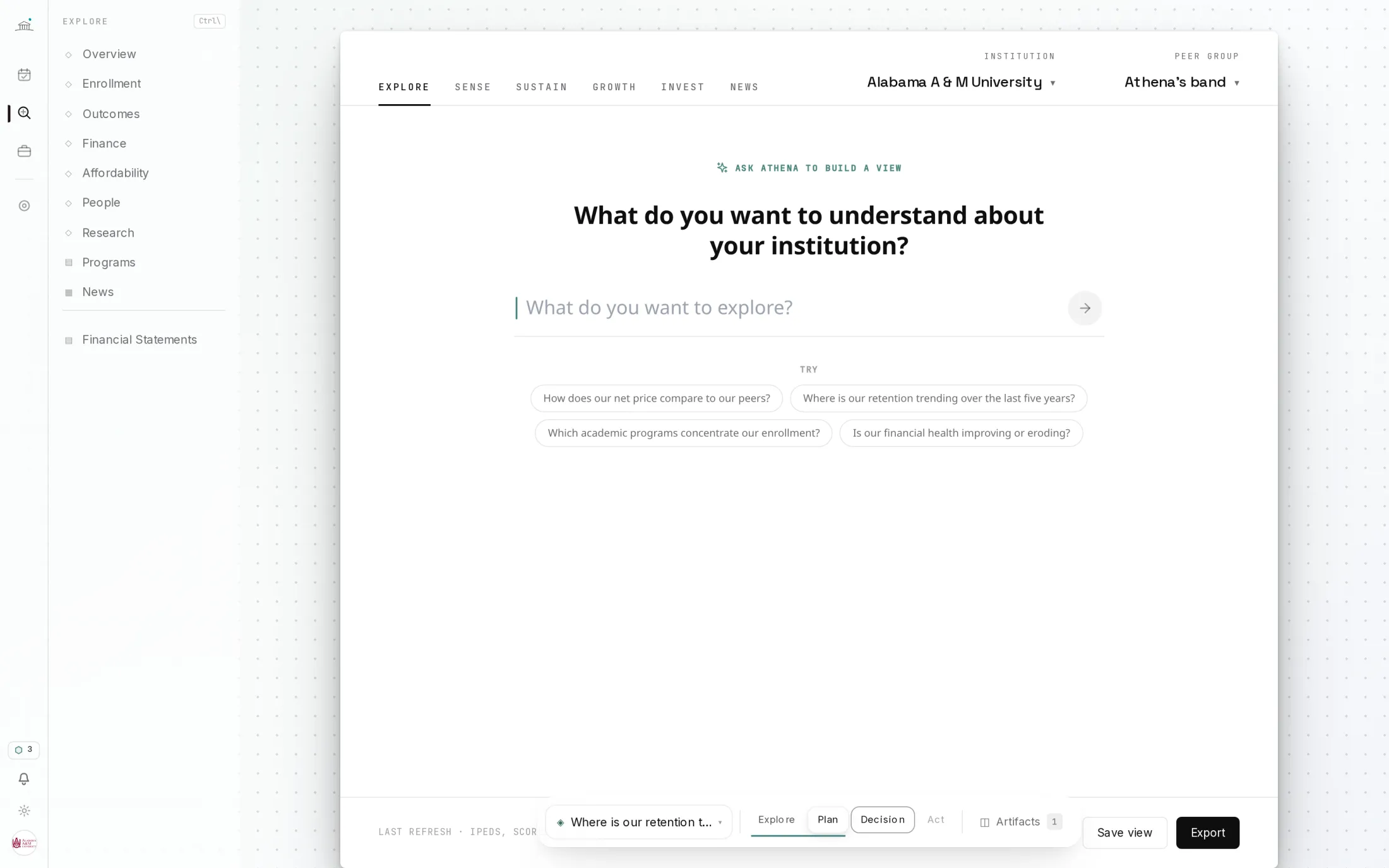
The Explore surface: a large prompt reads ‘What do you want to understand about your institution?’ above suggested questions, with the section navigation on the left.
The question every campus is hearing

“So — what’s our AI strategy?”

Every CFO, provost and president is being asked how the institution uses AI. Superiora is the answer for the back office — planning, research and decision orchestration — with the record to show for it.

For the CFO · the Provost · the President — and the board that’s asking

The case

Every question becomes a case.

One address for the whole argument. Every finding, plan, deck and decision names the case it came from — nothing reads as a document from nowhere.

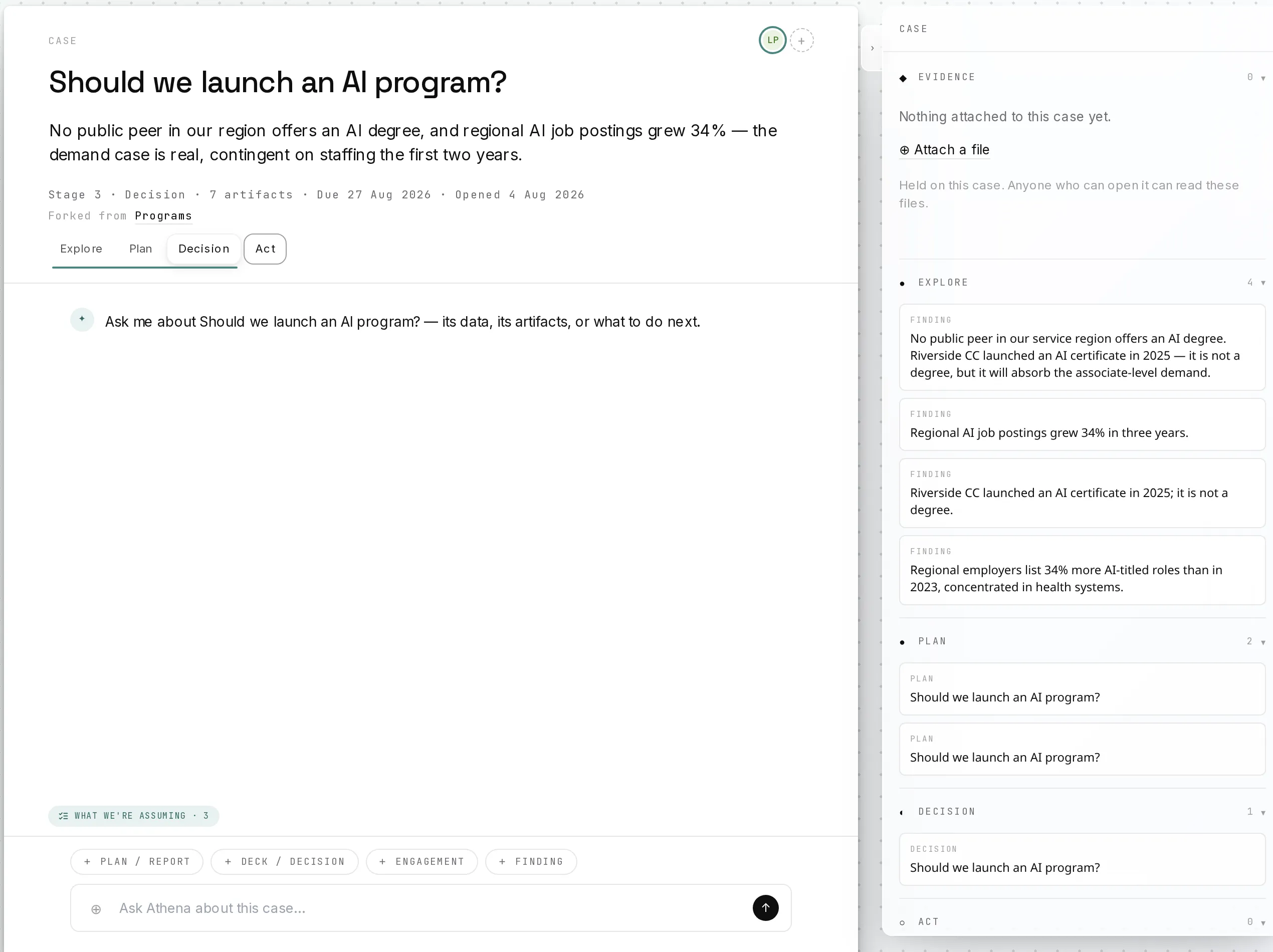
A case page titled ‘Should we launch an AI program?’ with its stage tabs and an evidence inspector listing four findings, two plans and a decision — fading out toward the bottom.
Close-up of the case’s stage tabs: Explore, Plan, Decision highlighted, Act — with ‘Forked from Programs’ above.
Four stages, one thread Explore → Plan → Decision → Act. The case remembers where it came from.
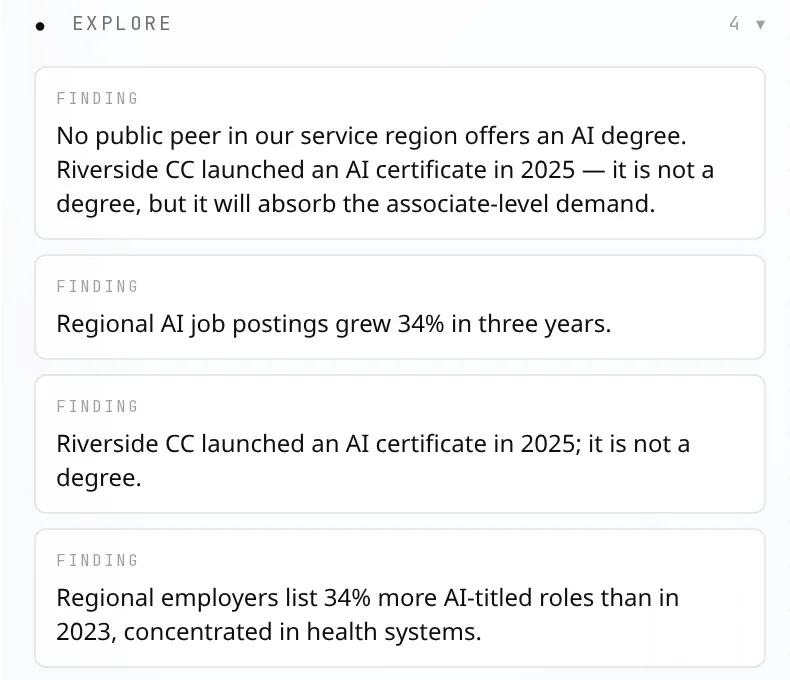
Close-up of the evidence inspector: four findings under Explore, including ‘Regional AI job postings grew 34% in three years.’
Evidence, pinned Findings stay attached to the case that produced them — with count and stage.
Close-up of the spine: the active case’s name beside its Explore/Plan/Decision/Act stages and an Artifacts count.
The spine The active case rides the bottom of every page — one click from anywhere.
Stage 1 · Explore

Meet Athena.

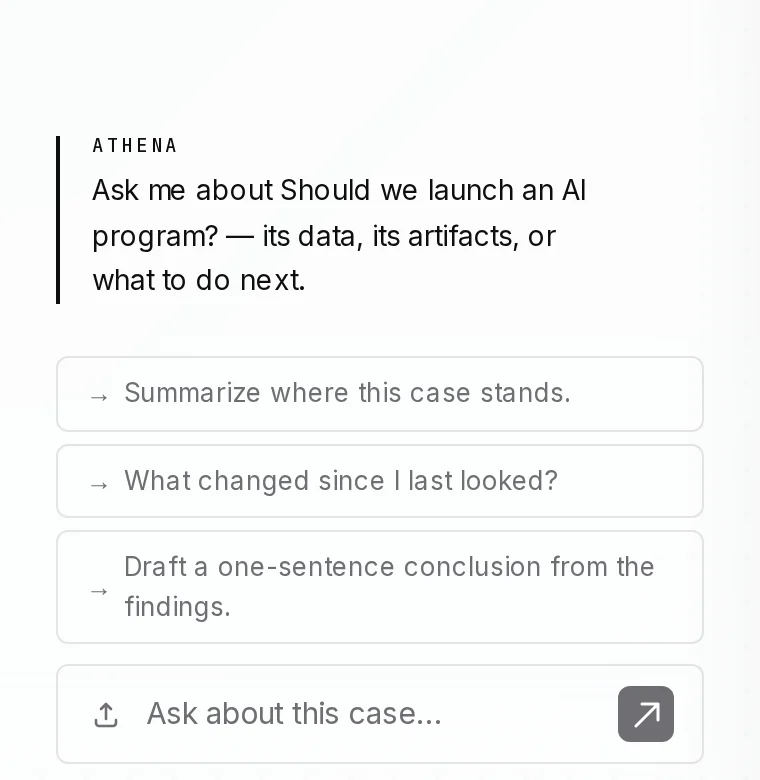
A colleague who has already read everything. Athena answers from your institution’s data — and says so when the record can’t support an answer.

An answer worth keeping becomes a finding in one click. Findings are what plans and board packs compose from.

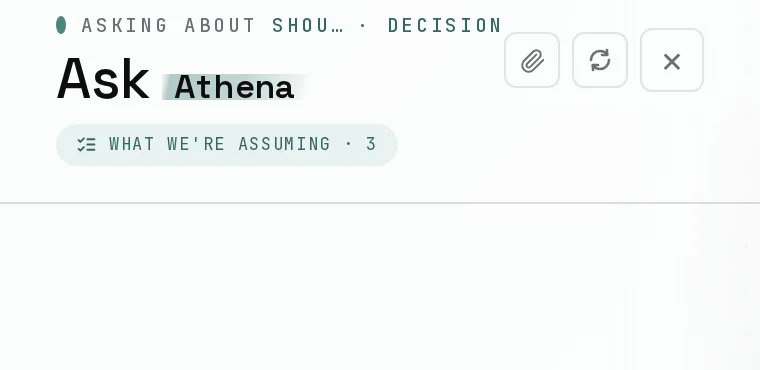
The Ask Athena panel header: asking about ‘Should we launch an AI program?’ at the Decision stage, with a ‘What we’re assuming · 3’ chip.
Athena’s panel: ‘Ask me about Should we launch an AI program? — its data, its artifacts, or what to do next’, with suggested asks and the composer.
Real data · forecast-aware

Your numbers arrive already benchmarked.

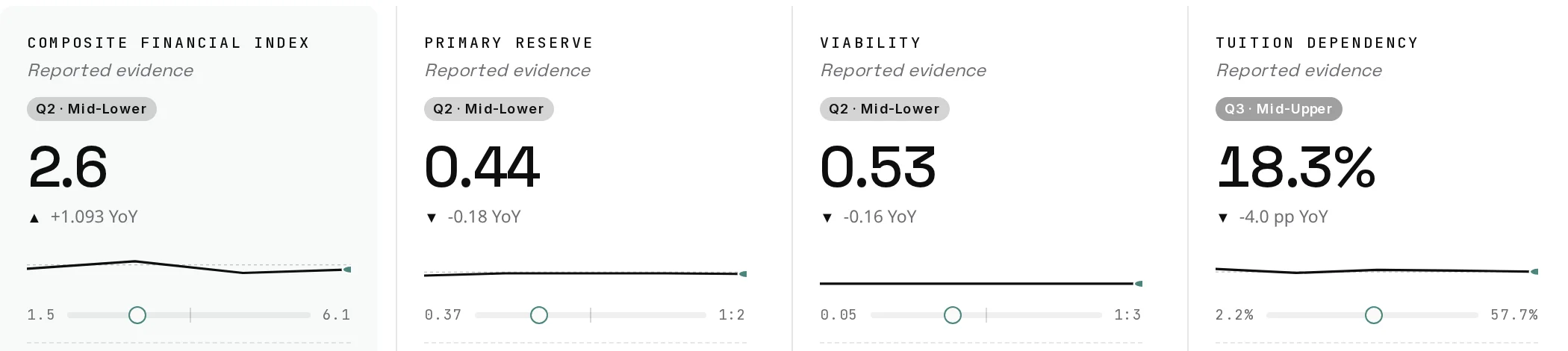
CFI ratios, enrollment funnels, program economics — refreshed from IPEDS and College Scorecard, and set against your peer group before you ask.

Four KPI cards in a row: Composite Financial Index 2.6, Primary Reserve 0.44, Viability 0.53 and Tuition Dependency 18.3% — each with a quartile band, a year-over-year arrow and a sparkline over the peer range.
Reported evidence, banded Every measure carries its quartile, its trend, and its place on the peer range.
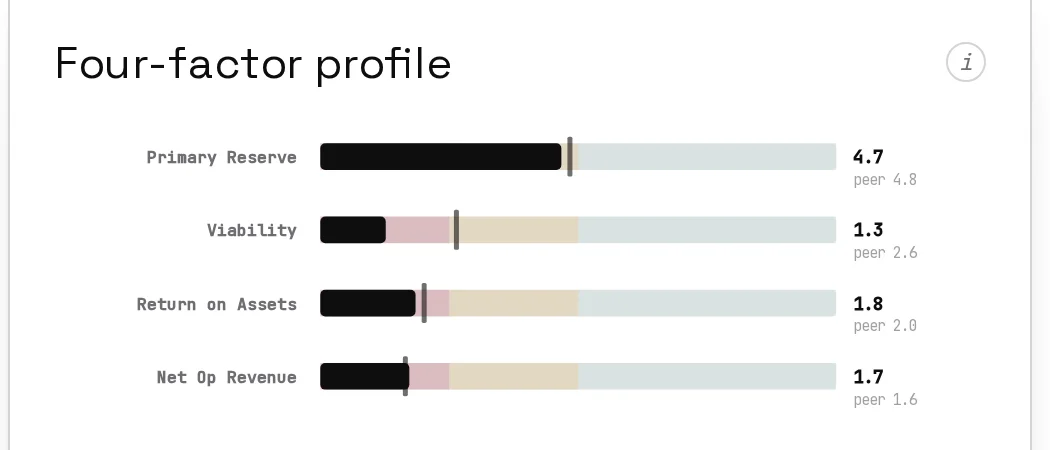
The four-factor profile: Primary Reserve 4.7 vs peer 4.8, Viability 1.3 vs 2.6, Return on Assets 1.8 vs 2.0, Net Op Revenue 1.7 vs 1.6, as horizontal bars with peer markers.
Peers on every bar Your four CFI factors, read against the cohort — not against a hunch.
Stage 2 · Plan

From findings to a plan someone signs.

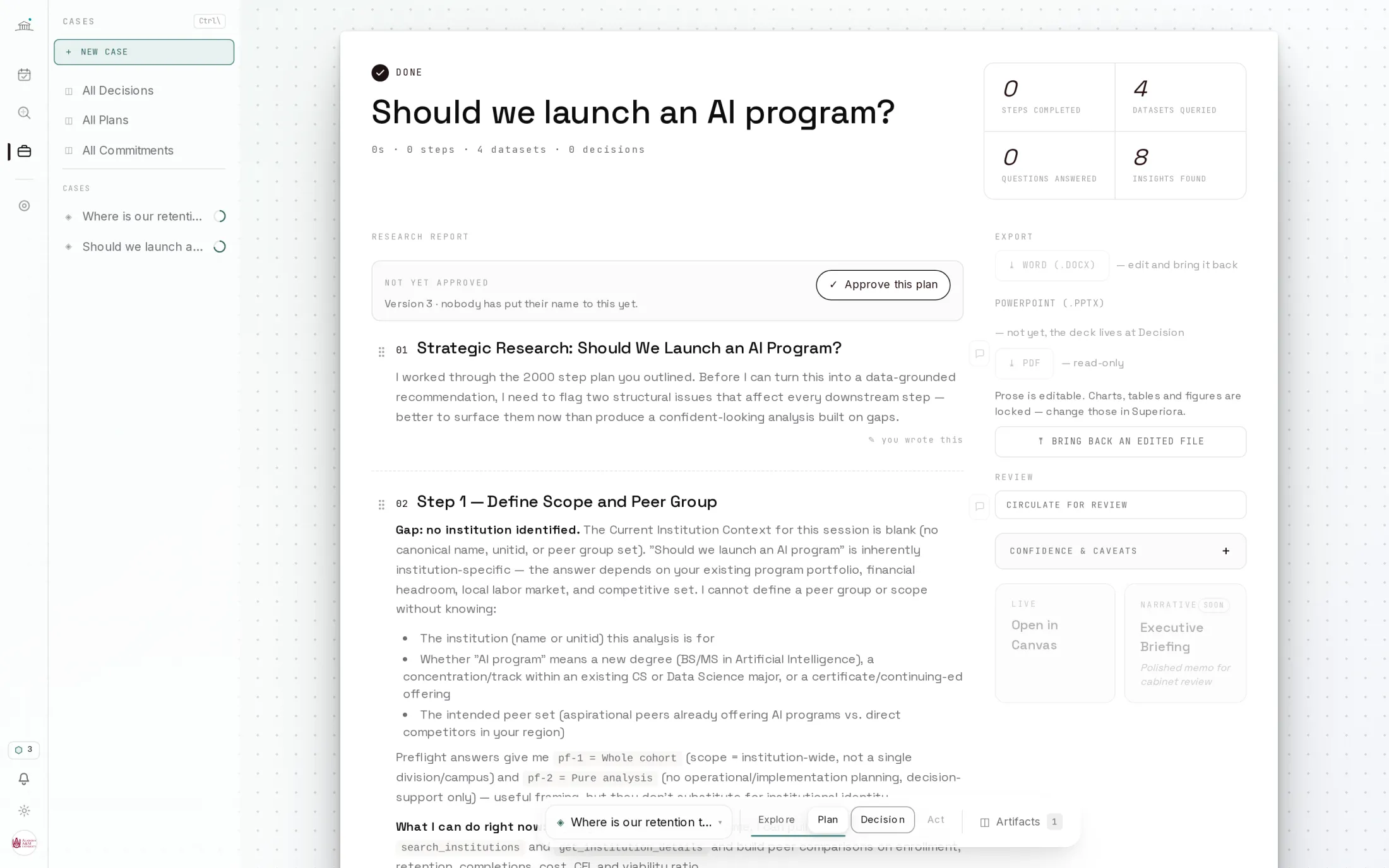
Athena drafts the report from the case’s findings; you edit it like paper. Then approve it on the record — or round-trip it through Word with the comments intact.

A completed research plan with numbered sections, an ‘Approve this plan’ button, Word/PDF export, ‘Bring back an edited file’ and ‘Circulate for review’ actions.
Close-up of the export panel: Word (.docx) — edit and bring it back, PowerPoint (.pptx), PDF read-only, and a ‘Bring back an edited file’ button.
Close-up of the approval bar: ‘Not yet approved — Version 3, nobody has put their name to this yet’ beside an ‘Approve this plan’ button.
Stage 3 · Decision

The board pack assembles itself.

Promote the plan and the packet drafts itself — summary, standing, options, recommendation. The ballot is part of the document.

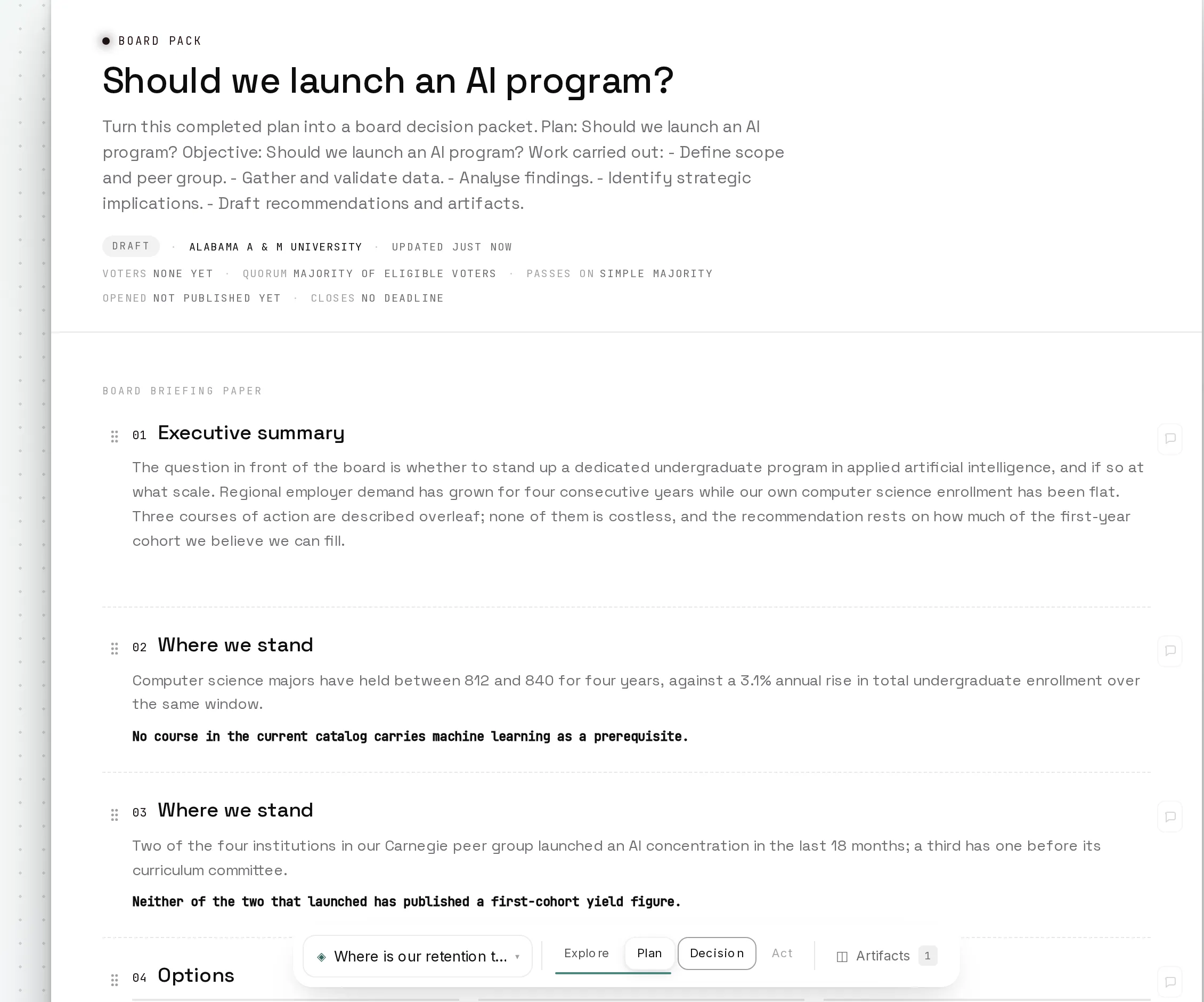
A board pack titled ‘Should we launch an AI program?’ with draft status, voter and quorum lines, and briefing sections — executive summary, where we stand, options — fading out toward the bottom.
Close-up of the packet’s terms: draft status, Alabama A&M University, voters none yet, quorum majority of eligible voters, passes on simple majority, not published yet, no deadline.
The terms, on the record Quorum, majority rule and deadline are set before anyone votes.
Present

Full screen. No chrome. Just the argument.

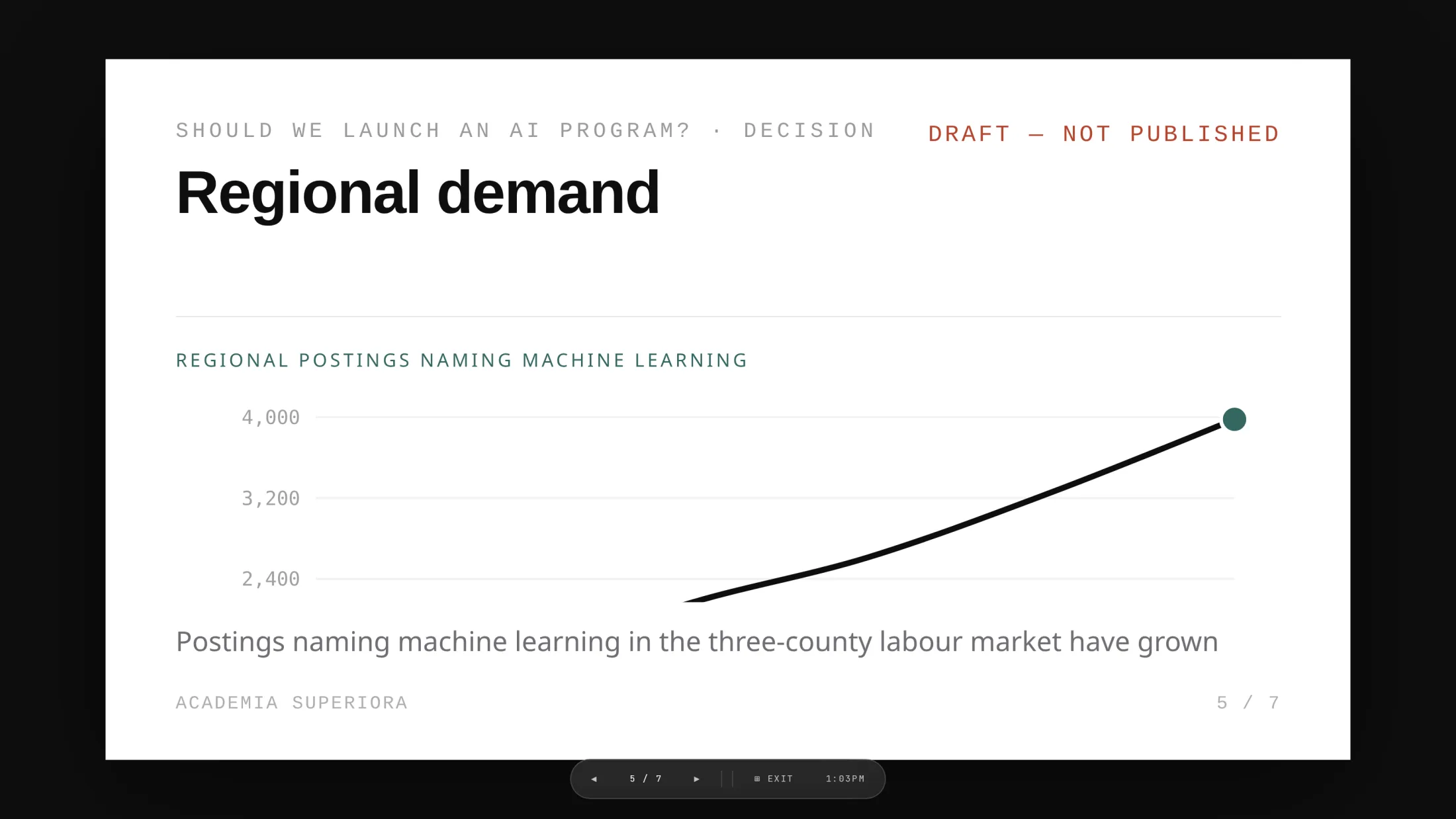
The pack becomes a deck; presenting is its own room. The last slide is a QR code — every phone in the room gets a ballot.

A full-bleed presented slide titled ‘Regional demand’ showing a rising line chart of regional job postings naming machine learning, slide 5 of 7.
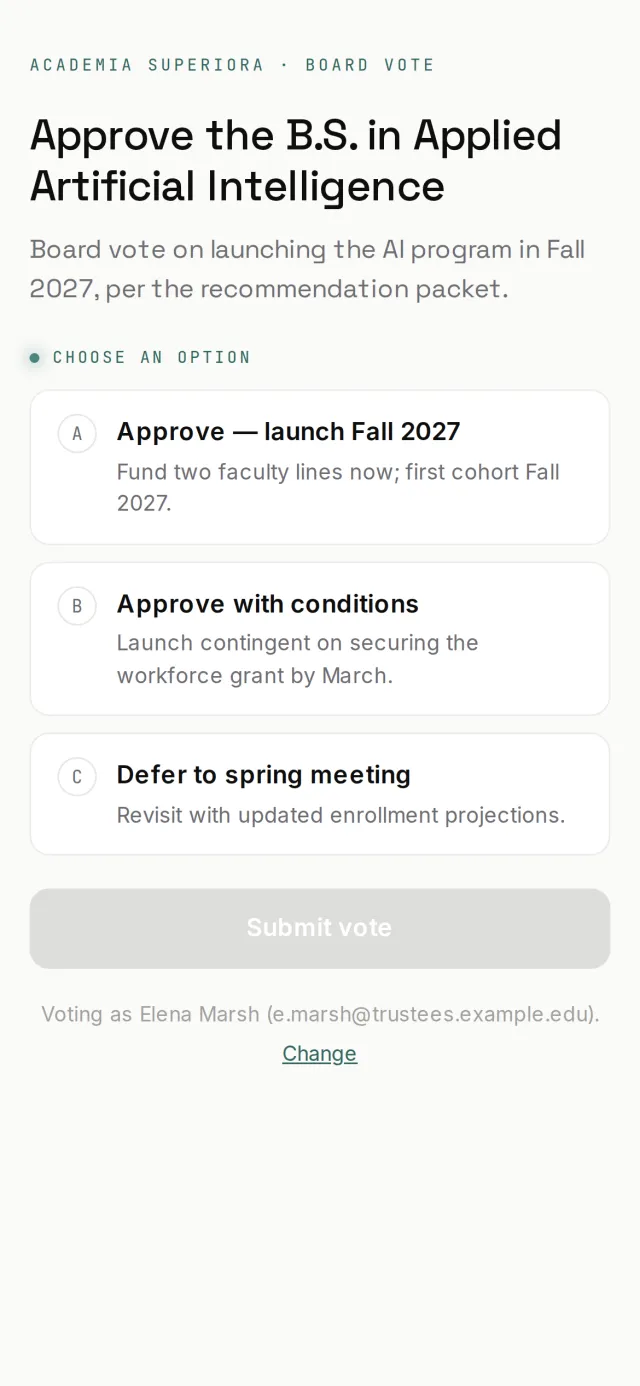
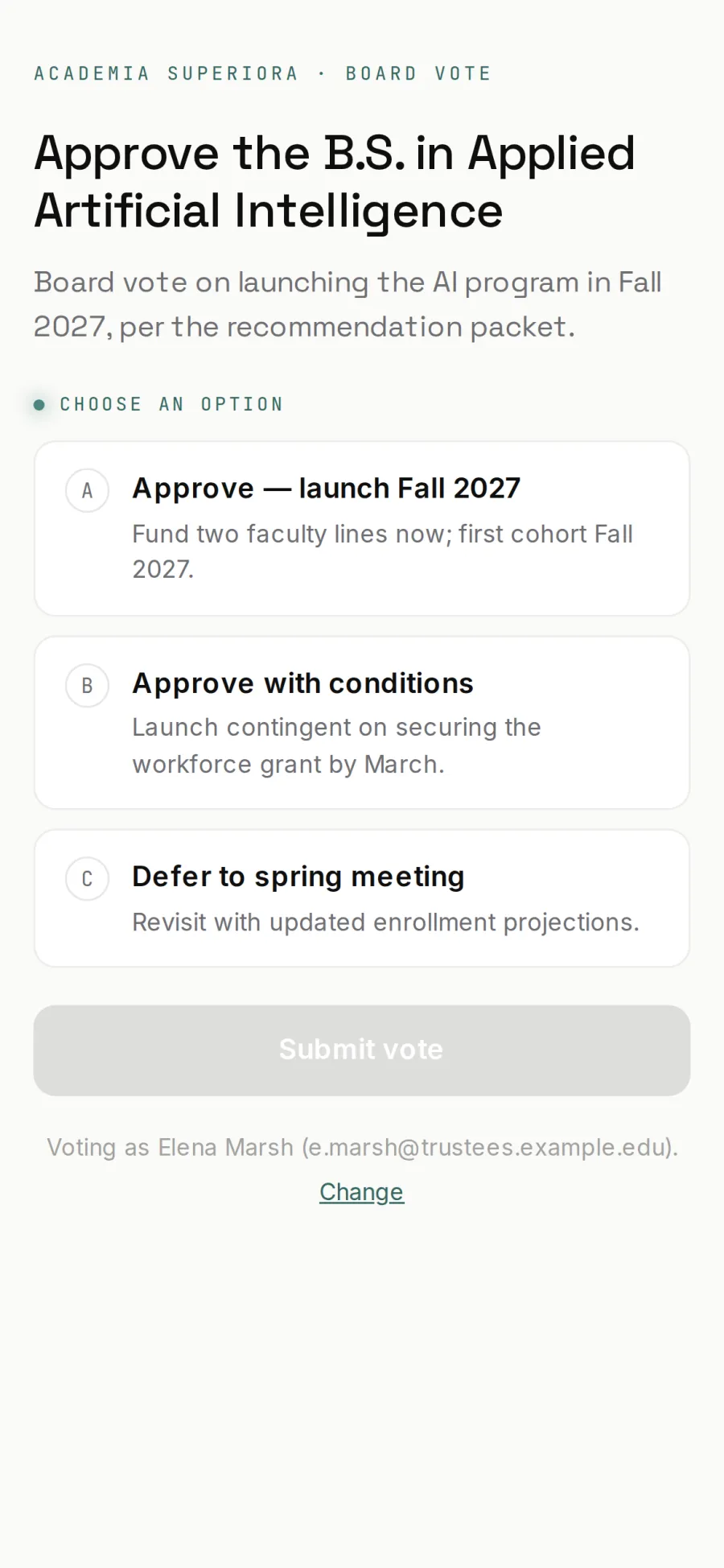
The phone that scanned the deck’s QR code, showing the ballot for ‘Approve the B.S. in Applied Artificial Intelligence’.

Presenting survives a reload because the presentation is a route, not a view state — the wall and the phones stay in step.

The vote

Decided on their own phones.

The CFO signs off, or the board votes it properly. Quorum and majority are computed, not eyeballed — and the outcome freezes onto the case record.

A phone ballot: ‘Approve the B.S. in Applied Artificial Intelligence’ with options A, B and C and a Submit vote button, voting as Elena Marsh.
The ballot
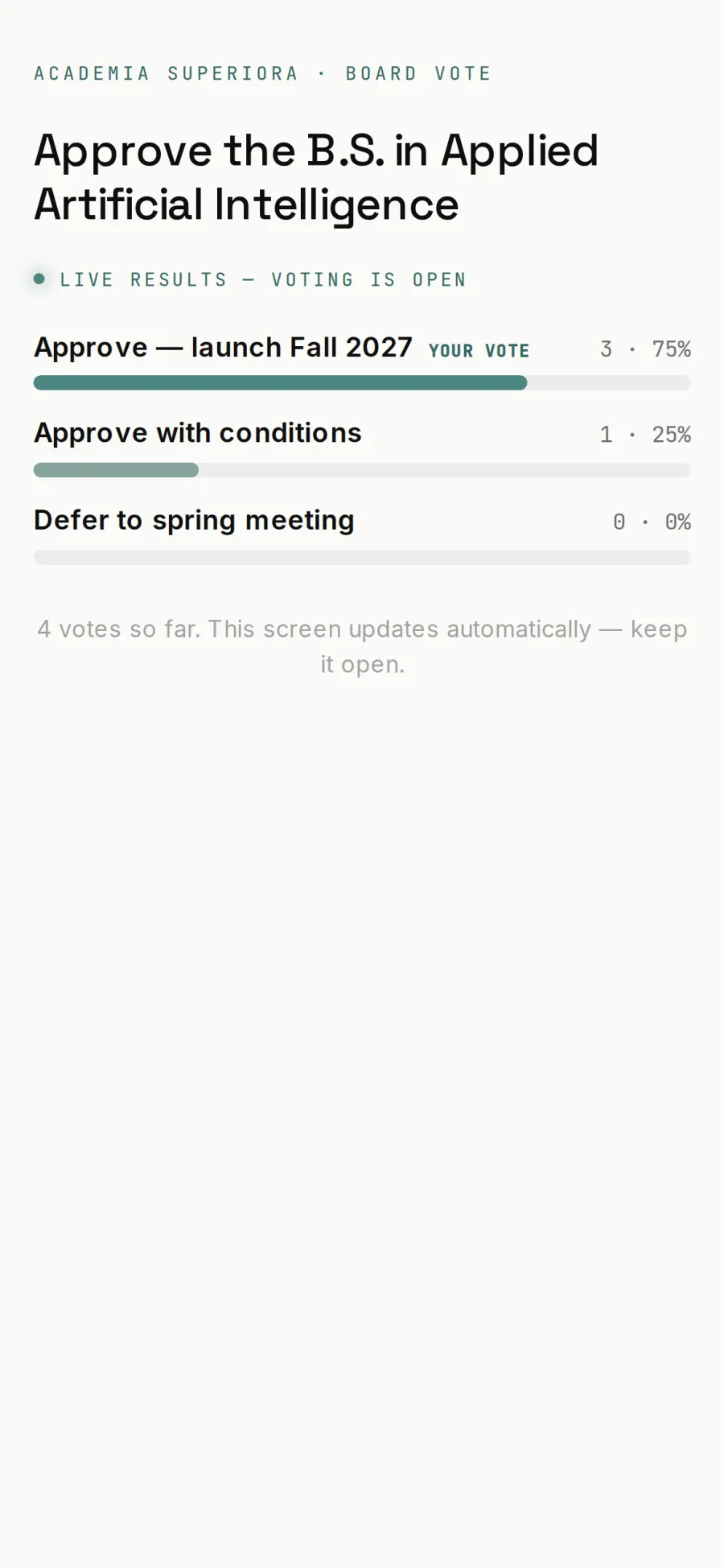
The tally is live — quorum met, majority computed, and the moment voting closes the outcome freezes onto the case.
Live results on a phone: Approve — launch Fall 2027 at 75%, Approve with conditions 25%, Defer 0%; four votes so far, voting open.
Live results
And all the small things

Built for how institutions actually decide.

Word, round-trip

Export a plan to .docx, let the provost edit it anywhere, and bring it back — comments imported, changes diffed.
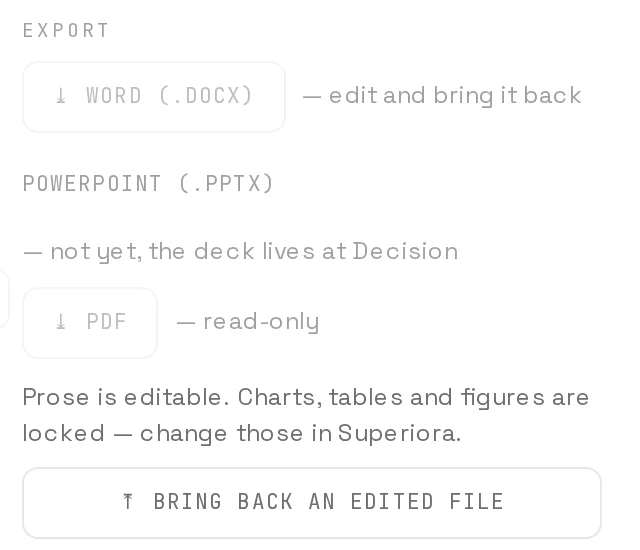
The export panel: Word (.docx) — edit and bring it back, PowerPoint, PDF read-only.

PowerPoint export

Decks leave as real .pptx files, faithful to the slides on the wall.
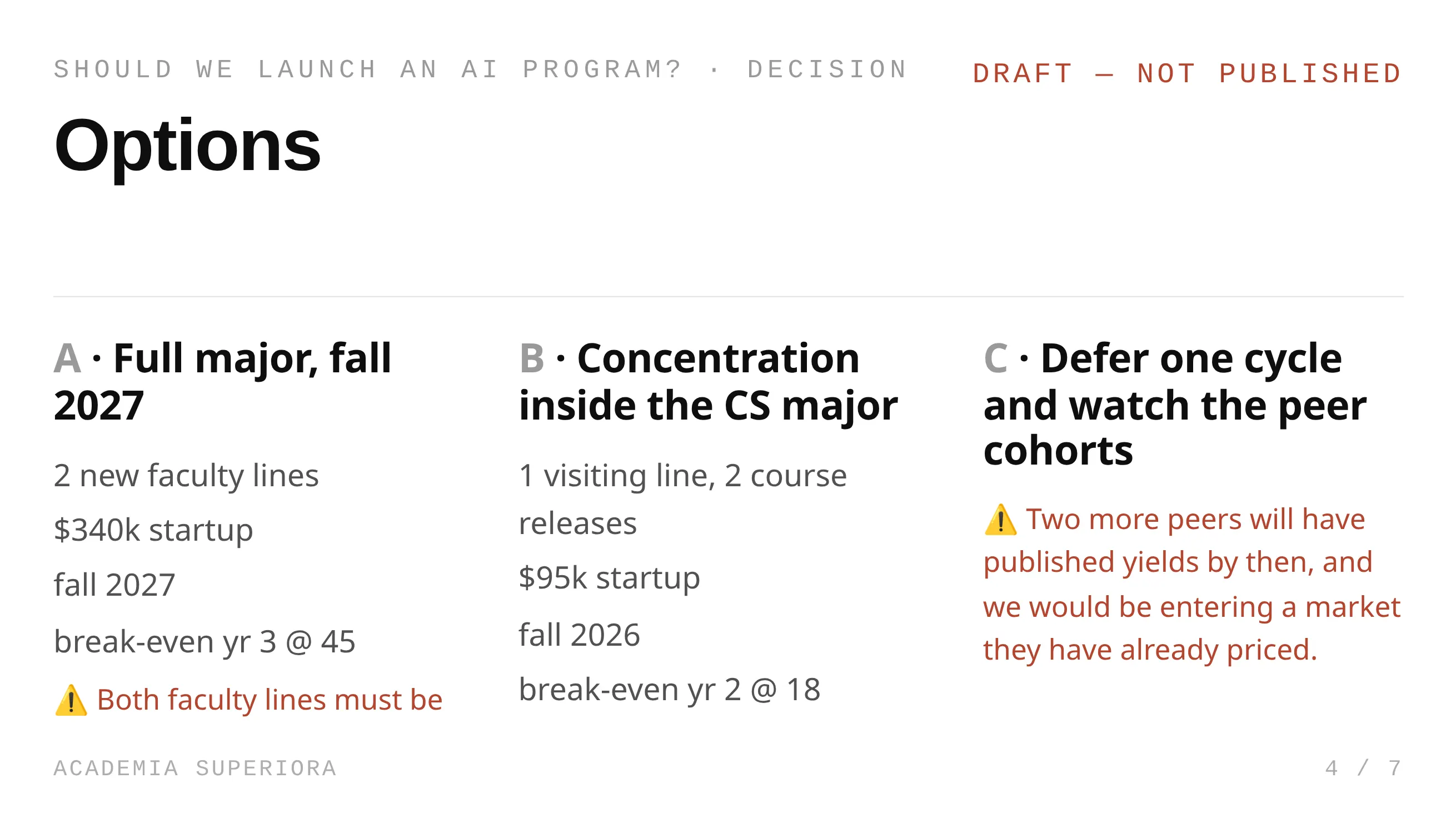
An exported Options slide with three lettered options and their costs.

Live slide edits

Ask for a change mid-presentation and the slide updates without leaving full screen.

Peer groups

Nine cohorts per institution out of the box — or ask Athena to draw a custom band around you.
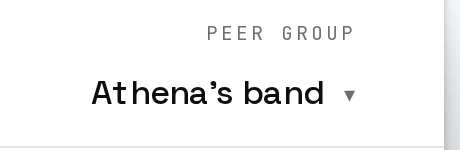
The peer group selector reading ‘Athena’s band’.

Deep research

Athena’s research mode plans its own queries, delegates, and returns a grounded report with sources attached.

A paper trail by construction

Nothing is ever hard-deleted. Cases archive and restore; published packs amend rather than mutate.

Commitments, tracked

What you promised the board lives in its own lens — beside cases, findings, plans and decisions.

Guests vote in seconds

A scanned QR asks for a name and an email — no account, no app, one ballot per voter.

Honest by wiring

When the data can’t support an answer, Athena says so — refusal is a first-class result, not a failure.

Academia Superiora

Your next hard question is waiting.

Open a domain, ask the question, and let the case carry it — from first curiosity to an outcome the record can defend. And when the board asks how you’re using AI — show them.