
A job · 0 credits
Your net price and aid, against your peers
What students pay by family income, and the aid you give, against your peers. One press, and a deck and a workbook come back.
What it measures
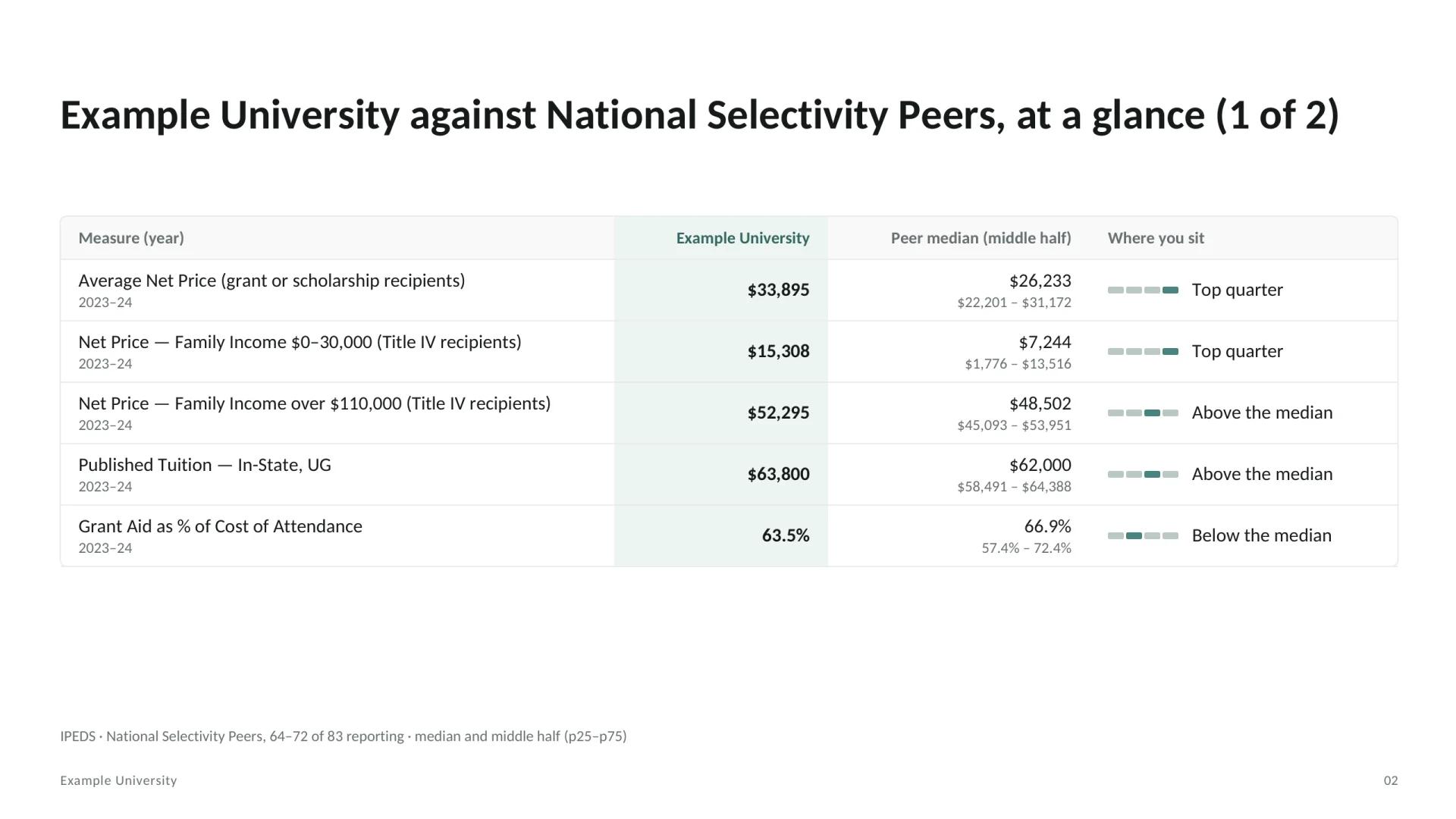
8 measures, each over the last ten years, against the peer median and the middle half of your peers. Each is named as the deck names it, with the survey behind it.
- Average Net Price (grant or scholarship recipients)IPEDS Student Financial Aid
- Net Price — Family Income $0–30,000 (Title IV recipients)IPEDS Student Financial Aid
- Net Price — Family Income over $110,000 (Title IV recipients)IPEDS Student Financial Aid
- Published Tuition — In-State, UGIPEDS Institutional Characteristics
- Grant Aid as % of Cost of AttendanceIPEDS Student Financial Aid and Institutional Characteristics
- Avg Institutional Grant AmountIPEDS Student Financial Aid
- % Receiving Institutional GrantsIPEDS Student Financial Aid
- Net Tuition per FTE (Rate, $ per student)IPEDS Finance and Fall Enrollment
How it runs
01 · Press
Press the job.
Pick it from the + menu or the Explore overview; a new account also finds the jobs in its morning brief. A project opens, named for your institution.
02 · Check
Each measure is set against your peers.
Your figure, the peer median and the middle half of your peer group, for the last ten years. A measure your institution does not report is named as a gap, never drawn as a zero.
03 · Deck and workbook
A deck and a workbook come back.
The deck, as .pptx and .pdf, opens with an at-a-glance slide, then one slide per measure, each naming its source and years. The workbook (.xlsx) has an at-a-glance sheet, one sheet per measure and a method sheet.
On our development servers on 2026-10-19, it took 8–15 seconds from the press to the deck on disk, in two to four clicks.
No AI model runs between the press and the file.
It compares you with the peer group you chose. If you have not chosen one, it uses a default cohort, and the deck names the rule that picked it.
What it costs: 0 credits
- A Free account can run it, within the Free plan’s five active projects.
- Asking Athena about the deck afterwards is a research question: 1 credit.
What it is not
Grant aid as a share of the cost of attendance is a proxy every institution reports to IPEDS the same way, so peers can be compared. It averages over first-time, full-time students who received aid, and counts federal, state and local grants as well as yours. It is not the discount rate your business office computes from its own books.
Questions about this job
Which prices and aid does the net price job compare?
The average net price, the net price for families earning $0–30,000 and over $110,000, published in-state tuition, grant aid as a share of the cost of attendance, the average institutional grant, the share of students receiving one, and net tuition per student.
Is grant aid as a share of the cost of attendance a discount rate?
It is a proxy that every institution reports to IPEDS the same way, so peers can be compared. It is not the discount rate your business office computes from its own books.
Are the net price dollars adjusted for inflation?
No. The job shows each year’s dollars as IPEDS published them.